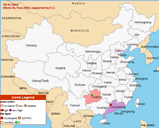
Gautier Richard, etc.,al. [preprint]Major change in swine influenza virus diversity in France owing to emergence and widespread dissemination of a newly introduced H1N2 1C genotype in 2020. https://doi.org/10.1101/2024.07.25.605108. Abstract
submitted by kickingbird at 1 days ago from https://doi.org/10.1101/2024.07.25.605108
Swine influenza A viruses (swIAV) are a major cause of respiratory disease in pigs worldwide, presenting significant economic and health risks. These viruses can reassort, creating new strains with varying ... Javed Riaz, Rachael A. Orben, Amandine Gamble,. Coastal connectivity of marine predators over the Patagonian Shelf during the highly pathogenic avian influenza outbreak. Ecography, 22 July 2024. Abstract
submitted by kickingbird at 1 days ago from Ecography, 22 July 2024
Animal movement and population connectivity are key areas of uncertainty in efforts to understand and predict the spread of infectious disease. The emergence of highly pathogenic avian influenza (HPAI) ... Palme Diana I, Lang Juliane, Helke Dajana, Kuryshk. Strain-dependent variations in replication of European clade 2.3.4.4b influenza A(H5N1) viruses in bovine cells and thermal inactivation in semi-skimmed or whole milk. Euro Surveill. 2024;29(30):pii=2400436. Abstract
submitted by kickingbird at 1 days ago from Euro Surveill. 2024;29(30):pii=2400436
Cattle were once thought to be resilient to avian influenza virus (AIV) infections, until the recent widespread influenza A(H5N1) virus infections in dairy cattle in several states in the Unites Stares ... Schmitz A, Pertusa M, Le Bouquin S, Rousset N, Ogo. Natural and Experimental Persistence of Highly Pathogenic H5 Influenza Viruses in Slurry of Domestic Ducks, with or without Lime Treatment. Appl Environ Microbiol. 2020 Nov 24;86(24):e02288-. Abstract
submitted by kickingbird at 2 days ago from Appl Environ Microbiol. 2020 Nov 24;86(24):e02288-
Infections by A/H5 and A/H7 avian influenza viruses (AIVs) can cause acute disease and are therefore notifiable in poultry and wild birds. During winter 2015-2016, several cases of infection caused by ... Ahrens AK, Selinka HC, Mettenleiter TC, Beer M, Ha. Exploring surface water as a transmission medium of avian influenza viruses - systematic infection studies in mallards. Emerg Microbes Infect. 2022 Dec;11(1):1250-1261. Abstract
submitted by kickingbird at 2 days ago from Emerg Microbes Infect. 2022 Dec;11(1):1250-1261
Mallards (Anas platyrhynchos) are an abundant anseriform migratory wild bird species worldwide and an important reservoir for the maintenance of low pathogenicity (LP) avian influenza viruses (AIV). They ... | |

 -
-